

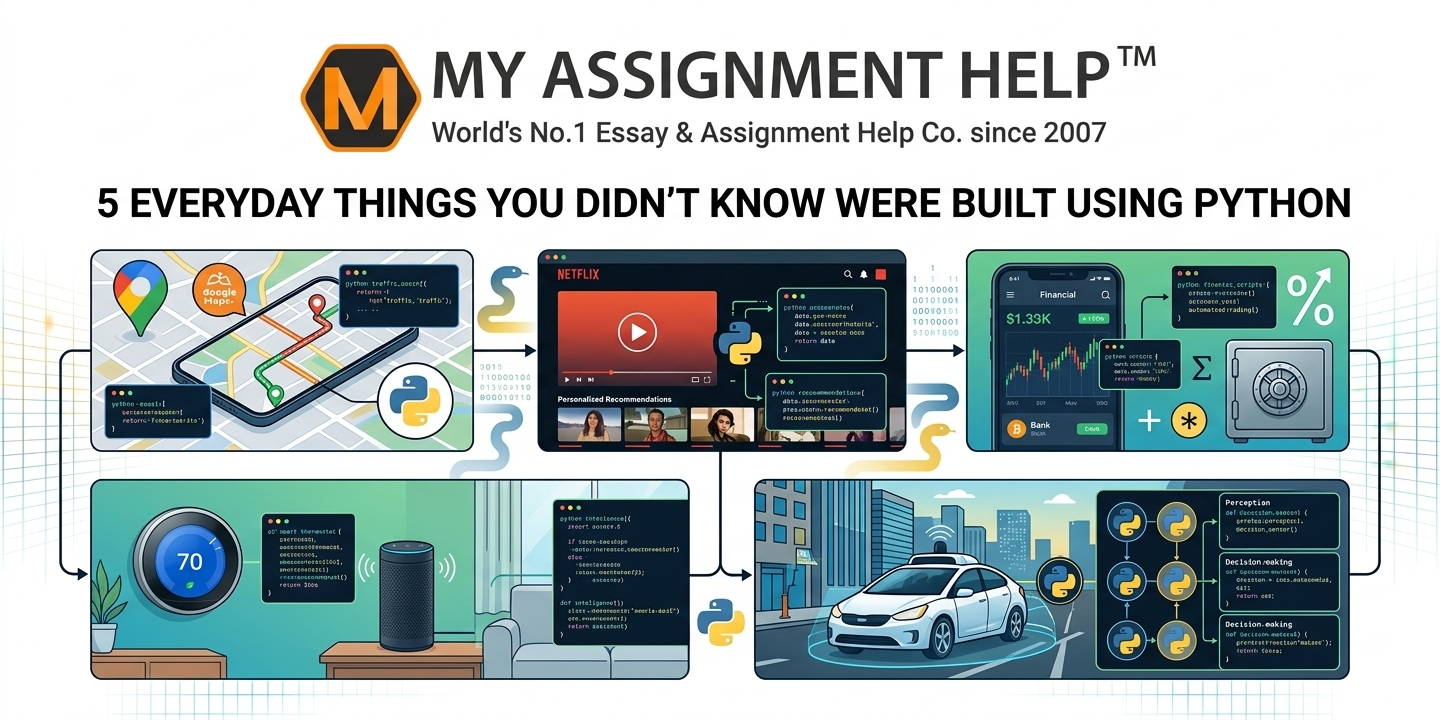


When Guido van Rossum created Python in the late 1980s as a hobby project, he envisioned a programming language that was deeply readable, intuitive, and highly functional. He named it after the British comedy troupe Monty Python’s Flying Circus—a nod to its accessible, unconventional nature. Today, that hobby project has evolved into the foundational bedrock of the modern digital ecosystem.
https://www.example.com/?MO4Okh-a65d85According to the TIOBE Index (May 2026), Python securely maintains its position as the world’s most popular programming language, commanding a massive lead in developer community engagement and enterprise adoption. While tech enthusiasts recognize Python’s dominance in artificial intelligence (AI), machine learning (ML), and data science, everyday consumers remain largely unaware of how deeply embedded this single language is in their daily routines. From the algorithms that dictate your evening relaxation to the underlying architecture safeguarding your financial transactions, Python operates silently behind the scenes.
For aspiring developers and students navigating complex computer science curricula, understanding these real-world deployments bridges the gap between abstract syntax and global utility. However, mastering syntax errors, object-oriented paradigms, and framework integrations can feel overwhelming. If you are currently struggling to grasp these advanced development concepts, seeking specialized Python Homework Help from trusted platforms like myassignmenthelp can provide the structured guidance and clarity needed to master the language.
Beyond specific languages, managing an entire engineering or academic workload requires strong time-management skills. When balancing multiple theoretical courses alongside intensive lab work, it is easy to fall behind on deadlines. For comprehensive academic support that spans multiple subjects, choosing to let professionals make my assignment can optimize your schedule, allowing you to focus purely on building tangible, hands-on coding projects.
Let’s pull back the curtain on five everyday digital services, platforms, and utilities that you rely on constantly, all built using Python.
The Python Digital Blueprint
To appreciate why the world’s largest tech conglomerates choose Python, we must analyze its structural breakdown within enterprise applications. Python’s design philosophy balances rapid prototyping with enterprise-scale stability.
[Python Enterprise Architecture]
│
├──► Web Frameworks (Django, Flask) ──► Used by: Instagram, Spotify
├──► Data Science & ML (NumPy, PyTorch) ──► Used by: Netflix, Uber
└──► Scripting & Automation (Boto3, Requests) ──► Used by: Dropbox, Stripe
1. Your Evening Binge-Watching: Netflix’s Recommendation Engine
When you open Netflix after a long day, you are greeted with a highly personalized dashboard featuring curated rows like “Top Picks for You” or “Because You Watched.” This hyper-targeted curation is not random; it is powered by a massive, real-world data engine driven primarily by Python.
The Technical Backbone
Netflix engineers use Python across the entire lifecycle of their infrastructure—from content delivery networks (CDNs) to complex machine learning algorithms. In a comprehensive technical review published via the Netflix Tech Blog, the company detailed how Python is utilized within their Central Science and Analytics teams.
- Machine Learning Models: Netflix leverages Python libraries such as NumPy, SciPy, and PyTorch to run deep learning algorithms. These algorithms process billions of data points: what time you watch, when you pause a show, your scrolling speed, and device types.
- Open Connect Content Delivery: Python helps manage Netflix’s custom CDN, which is responsible for streaming data efficiently to over 260 million global subscribers. Python scripts automate the network routing, ensuring that high-definition video is cached on servers physically closest to the end-user, minimizing buffering.
Data Metric
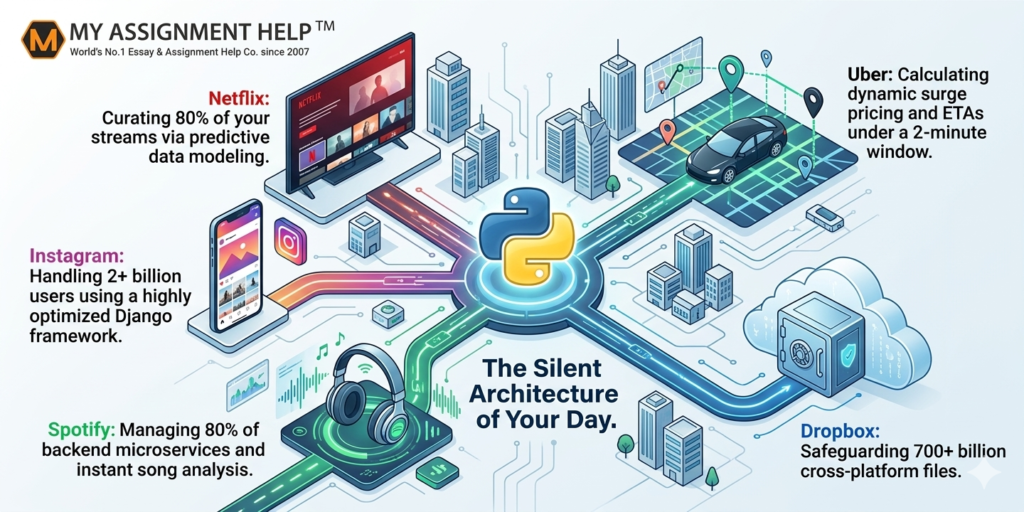
According to historical data from Netflix’s investor metrics and system performance leaks, the Python-driven recommendation engine accounts for over 80% of the content streamed on the platform. This precise personalization saves Netflix an estimated $1 billion annually in customer retention costs by keeping viewers continuously engaged.
2. Your Daily Visual Feed: The Scale and Infrastructure of Instagram
With over 2 billion active monthly users globally, Instagram is one of the largest web applications in existence. It handles millions of photo and video uploads every single minute. What surprises many is that the primary web framework handling this monumental traffic load is written almost entirely in Python.
The Technical Backbone
Instagram utilizes Django, a high-level Python web framework that encourages rapid design and clean, pragmatic development.
- Scaling Django: When Instagram was acquired by Meta (formerly Facebook), critics doubted whether a Python framework could handle billions of concurrent queries. Instagram disproved this by scaling its infrastructure using a highly optimized version of Django running on Python 3.
- Efficiency at Scale: Instagram’s engineering team frequently contributes back to the open-source community. They have engineered custom modifications to Python’s Garbage Collection (GC) mechanisms to maximize CPU efficiency, allowing their servers to process web requests with minimum latency.
Data Metric
Instagram’s web tier runs one of the world’s largest deployments of the Django framework. According to internal engineering presentations at PyCon, optimizing their Python execution runtime allowed Instagram to reclaim up to 10% of their server CPU capacity, showcasing that Python can scale to serve a quarter of the world’s population efficiently.
3. Your Soundtrack to Life: Spotify’s Data-Driven Playlists
Whether you are listening to “Discover Weekly” or customized daily mixes, Spotify seems to understand your musical taste better than anyone else. This seamless music delivery and algorithmic discovery process relies on Python for both backend services and intensive data analytics.
The Technical Backbone
Spotify’s backend is composed of thousands of cooperative microservices. While a portion of these are written in Java and C++, approximately 80% of these services are built on Python.
- Algorithmic Discovery: Spotify uses Python to perform Collaborative Filtering and Natural Language Processing (NLP). The system scans the web for music blogs, playlists, and reviews to understand how people talk about artists, grouping songs by contextual mood rather than just genre.
- Audio Analysis: Python scripts run digital signal processing algorithms on raw audio files to analyze a track’s tempo, acousticness, danceability, and energy level.
Data Metric
Spotify boasts over 600 million active users. Python’s processing efficiency allows the platform to analyze over 100 million tracks simultaneously, translating trillions of user interactions (skips, repeats, saves) into customized playlist updates every single Monday morning.
4. Your Digital Security Vault: Dropbox’s File Synchronization
Before cloud storage became a standard operating system feature, Dropbox pioneered seamless file synchronization. Keeping files identical across a smartphone, a Windows PC, a Mac, and a web browser simultaneously is an immensely complex engineering challenge. Dropbox solved it by utilizing Python for both client-side and server-side operations.
The Technical Backbone
Dropbox was built from day one on Python. In fact, the company hired Guido van Rossum, Python’s creator, where he spent over six years refining the platform’s core architecture.
- Cross-Platform Uniformity: Python’s cross-platform compatibility allowed Dropbox engineers to write a single, unified client application that runs natively across diverse operating systems.
- Performance Optimization: To ensure that file syncing did not hog computer memory, Dropbox engineered custom Python compilers and optimization frameworks, allowing them to execute code quickly on consumer hardware.
Data Metric
Dropbox manages over 700 million registered users and stores exabytes of data. Python handles the secure routing, user authentication, and data integrity checks across 700+ billion files uploaded to the platform, highlighting the language’s security and stability.
5. Navigating Your City: Uber’s Dynamic Routing and Pricing
When you request a ride on Uber, several computational calculations occur within seconds: finding nearby drivers, predicting the exact time of arrival (ETA), and calculating the price based on current traffic and demand. Python manages this real-time optimization loop.
The Technical Backbone
Uber’s complex marketplace platform coordinates drivers and riders dynamically. Their engineering stack relies heavily on Python to handle unpredictable real-world variables.
- Dynamic Pricing (Surge): Python engines run predictive models that evaluate passenger demand and driver supply in real-time. If demand spikes in a specific city quadrant, Python scripts calculate the price increase instantly to incentivize more drivers to enter that zone.
- ETA Calculations: Through data science libraries, Uber runs machine learning simulations to forecast arrival times based on historical trip patterns, current weather conditions, and active traffic data.
Data Metric
Uber facilitates over 28 million rides per day worldwide. Python’s role in managing their data analytics infrastructure ensures that ETAs are calculated with an accuracy rate within a 1-to-2-minute window, reducing idle time for both drivers and passengers.
Key Takeaways for Aspiring Developers
- Versatility is King: Python is not limited to a single domain. It transitions seamlessly from web applications (Instagram) to data science (Netflix) and infrastructure systems (Dropbox).
- Scalability is a Proven Fact: Despite outdated misconceptions regarding execution speed, Python handles billions of daily users when optimized correctly by enterprise engineering teams.
- High Industry Demand: Companies like Google, Meta, Netflix, and Spotify continuously hunt for proficient Python developers, making it a highly lucrative language to learn.
- Strong Community & Ecosystem: Python’s vast library repository (NumPy, Django, PyTorch) means developers rarely have to reinvent the wheel, drastically speeding up development cycles.
Comprehensive Comparative Analysis
To see how these everyday platforms maximize Python across different paradigms, let’s look at their framework distributions:
| Brand Platform | Primary Python Use Case | Core Frameworks / Libraries Used | Key Scale Metric |
| Netflix | Recommendation Engine & CDN | PyTorch, NumPy, SciPy | Dictates 80% of user streams |
| High-Traffic Web Infrastructure | Django, Custom CPython optimizations | Serves 2+ billion monthly users | |
| Spotify | Microservices & Audio Analysis | Flask, Asyncio, GraphLab | Processes 100+ million music tracks |
| Dropbox | Desktop & Cloud File Sync | Custom Python Client, PyObjC | Safeguards 700+ billion files |
| Uber | Predictive Models & Surge Pricing | Tornado, NumPy, SciPy | Manages 28 million daily rides |
Frequently Asked Questions (FAQs)
1. Why do tech companies choose Python if languages like C++ or Java execute code faster?
While lower-level languages like C++ or Java have faster raw execution runtimes, Python excels in developer velocity—the speed at which engineers can write, test, and ship code. Furthermore, Python allows developers to write performance-critical components in C or C++ and wrap them in clean Python syntax. This hybrid approach gives enterprises the speed of C with the clean readability of Python.
2. Can you build mobile applications using Python?
Yes, though it is not Python’s primary use case. Frameworks like Kivy and BeeWare allow developers to create cross-platform mobile apps for iOS and Android using Python. However, most major enterprises prefer native languages (Swift for iOS, Kotlin for Android) for user interfaces, while running their underlying data processing servers on Python.
3. Is learning Python still relevant given the rise of newer languages like Rust or Go?
Absolutely. While Go is popular for microservices and Rust is preferred for system-level memory safety, neither possesses the extensive ecosystem that Python maintains in Data Science, Artificial Intelligence, and Machine Learning. The global tech infrastructure is heavily integrated with Python, ensuring it will remain relevant and highly sought-after for decades to come.
References and Authoritative Sources
- TIOBE Holding B.V. (2026). TIOBE Programming Community Index: Python Dominance Trend. Retrieved from https://www.tiobe.com/tiobe-index/
- Netflix Technology Blog. (2019). Python at Netflix. Retrieved from official Netflix medium engineering updates.
- Instagram Engineering. (2017). Web Service Efficiency at Scale with Python 3. Presented at PyCon US.
- Spotify Engineering Insights. (2020). How Spotify leverages Python microservices for streaming optimization.
About the Author
Marcus Vance is a Senior Technical Content Architect and Lead Programming Consultant at myassignmenthelp. With over 12 years of hands-on experience in full-stack software development, Marcus specializes in scaling Django frameworks and designing predictive machine learning pipelines. He holds a Master’s Degree in Computer Science from Georgia Institute of Technology and routinely provides educational mentorship, industry insights, and academic counseling to software engineering students globally.
